Storage Capacity Discrepancies (Decimal vs. Binary)
The Naming Standard: SI vs. IEC Prefixes
A fundamental source of confusion in storage engineering is the overlap in terminology between Decimal (Base-10) and Binary (Base-2) measurements. To clarify this, the International Electrotechnical Commission (IEC) established distinct prefixes.
Decimal (SI) Units: Based on powers of 1,000. These are the “standard” Kilo, Mega, Giga, Tera, and Peta prefixes used by hardware vendors.
Binary (IEC) Units: Based on powers of 1,024. These use the “bi” syllable (Kibi, Mebi, Gibi, Tebi, Pebi) to signify “Kilo-Binary,” “Mega-Binary,” etc. These units reflect how operating systems and computer memory actually address data.
Comparison and the “Capacity Gap”
As storage capacity grows, the difference between these two systems increases significantly. At the Petabyte level, the discrepancy is over 12%.
|
Metric |
Decimal (SI) |
Binary (IEC) |
Difference |
|
Kilo vs Kibi |
1,000 bytes |
1,024 bytes |
~2.4% |
|
Mega vs Mebi |
1,000,000 bytes |
1,048,576 bytes |
~4.9% |
|
Giga vs Gibi |
1,000,000,000 bytes |
1,073,741,824 bytes |
~7.3% |
|
Tera vs Tebi |
1,000,000,000,000 bytes |
1,099,511,627,776 bytes |
~10.0% |
|
Peta vs Pebi |
1,000,000,000,000,000 bytes |
1,125,899,906,842,624 bytes |
~12.6% |
Operating System Presentation
Microsoft Windows
Windows calculates storage using Base-2 (1,024) but uses Base-10 labels (GB, TB, PB).
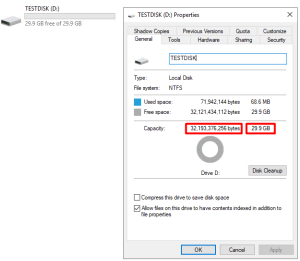
Calculation Example
In the screenshot, the disk reports 32,193,376,256 bytes.
To find the value Windows displays (in GiB but labeled as GB):
32,193,376,256 / 1,024 / 1,024 / 1,024 = 29.982 GiB
Windows rounds this to 29.9 GB.
VMware vSphere (ESXi)
VMware vSphere calculates storage using Base-2 (1,024) but uses Base-10 labels (GB, TB, PB).
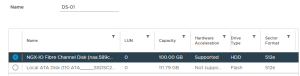
Linux
Linux utilities like ‘df’ allow the user to toggle between these two systems using different flags.

We see two different views of the same device (/dev/sdb):
1. df -H (Decimal/SI): Reports 53G (53,000,000,000 bytes).
2. df -h (Binary/IEC): Reports 49G.
Verification:
53,000,000,000 bytes / (1024^3) = 49.359 GiB.
This confirms that ‘df -h’ is displaying the binary capacity (49 GiB), labeled simply as G.
NGX Storage Capacity Representation
NGX Storage GUI shows capacity using Base-2 and uses label G.
A LUN of 100GiB capacity is shown below.

Conclusion: Strategic Technical Advice
To ensure you receive the storage capacity your systems actually need, always specify requirements in binary units like TiB or PiB rather than decimal TB or PB. Because operating systems calculate in base-2 while hardware specifications are often listed in base-10, failing to define the unit creates a “capacity gap” of 10% to 13% at the enterprise scale. All technical requirements should explicitly state that “usable capacity” is measured solely based on IEC binary standards to ensure the physical deployment matches the architectural design. This prevents a “cost of silence” error—for instance, requiring 5 PB instead of 5 PiB leaves the environment short by nearly 600 TiB of usable space. Correcting such a deficit after the initial deployment is significantly more complex and expensive than specifying the correct binary units from the start.
COPYRIGHT
© 2025 NGX Teknoloji A.Ş. (NGX Storage). All rights reserved. Printed in the Turkey. Specifications subject to change without notice. No part of this document covered by copyright may be reproduced in any form or by any means-graphic, electronic, or mechanical, including photocopying, recording, taping, or storage in an electronic retrieval system-without prior written permission of NGX Storage. Software derived from copyrighted NGX Storage material is subject to the following license and disclaimer:
THIS SOFTWARE IS PROVIDED BY NGX Storage “AS IS” AND WITHOUT ANY EXPRESS OR IMPLIED WARRANTIES, INCLUDING, BUT NOT LIMITED TO, THE IMPLIED WARRANTIES OF MERCHANTABILITY AND FITNESS FOR A PARTICULAR PURPOSE, WHICH ARE HEREBY DISCLAIMED. IN NO EVENT SHALL NGX Storage BE LIABLE FOR ANY DIRECT, INDIRECT, INCIDENTAL, SPECIAL, EXEMPLARY, OR CONSEQUENTIAL DAMAGES (INCLUDING, BUT NOT LIMITED TO, PROCUREMENT OF SUBSTITUTE GOODS OR SERVICES; LOSS OF USE, DATA, OR PROFITS; OR BUSINESS INTERRUPTION) HOWEVER CAUSED AND ON ANY THEORY OF LIABILITY, WHETHER IN CONTRACT, STRICT LIABILITY, OR TORT (INCLUDING NEGLIGENCE OR OTHERWISE) ARISING IN ANY WAY OUT OF THE USE OF THIS SOFTWARE, EVEN IF ADVISED OF THE POSSIBILITY OF SUCH DAMAGE.
NGX Storage reserves the right to change any products described herein at any time, and without notice. NGX Storage assumes no responsibility or liability arising from the use of products described herein, except as expressly agreed to in writing by NGX Storage. The use or purchase of this product does not convey a license under any patent rights, trademark rights, or any other intellectual property rights of NGX Storage.
TRADEMARK
NGX Storage and the NGX Storage logo are trademarks of NGX TEKNOLOJI A.Ş. Other company and product names may be trademarks of their respective owners.